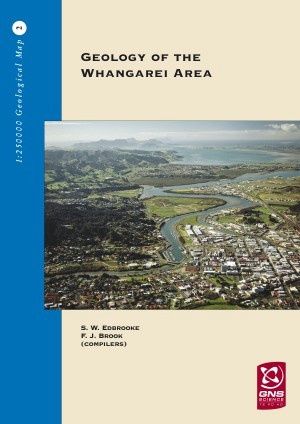
Geology Of The Whangarei Area
$35
Price incl. GST (15%) $4.57
In stock: 4 available
Product details
Edbrooke, S.W.; Brook, F.J. (comps) 2009
Geology of the Whangarei area. Lower Hutt: GNS Science. Institute of Geological & Nuclear Sciences 1:250,000 geological map 2
68 p. + 1 folded map
Abstract
The Whangarei 1:250,000 geological map covers:
- About 8700 km² of Northland, in the north of the North Island, New Zealand.
- A further 12,300 km² of the adjacent offshore area is also included.
Geographical Features
- The area is dominated by rolling dissected hill country up to about 400 m in elevation, with a few isolated ranges reaching heights of up to 770 m.
- Areas of flat land are uncommon and typically restricted to narrow river valleys and coastal areas.
- Offshore, the sea floor slopes gently to the shelf edge, located 16 to 60 km from the coast, at a water depth of about 150 m.
Geological Composition
The map area is underlain by Permian to Early Cretaceous basement rocks belonging to four tectonostratigraphic terranes:
- Exposed Terranes:
- In the east, greywacke and argillite of the Waipapa (composite) terrane crop out between Whangaroa Harbour and Te Arai Point, south of Mangawai Heads.
- In the northwest, metagreywacke and argillite with associated basalt, chert, and volcanic sediments forming the Waipapa horst are correlated with the Caples terrane.
- Concealed Terranes:
- Rocks of the Murihiku and Dun Mountain-Maitai terranes underlie southwestern parts of the map area.
Sequence and Units
- A predominantly transgressive sequence of Late Eocene to Oligocene coal measures, glauconitic sandstone, calcareous mudstone, and limestone of the Te Kuiti Group unconformably overlies basement rocks.
- The Cretaceous and Paleogene units present onshore are mainly displaced sedimentary rocks and ocean floor volcanics, occurring in thrust-bounded units and mélange of the Northland Allochthon, emplaced from the northeast in the Early Miocene.
- Mainly autochthonous Early Miocene shelf to bathyal sedimentary rocks of the Waitemata Group underlie, overlie, and are incorporated within the Northland Allochthon.
- Early Miocene Otaua Group sedimentary rocks unconformably overlie the allochthon in the northwest.
- Early Miocene subduction-related volcanism post-dating the Northland Allochthon produced several stratovolcano complexes, the eroded remnants of which are included in the Waitakere and Coromandel Groups.
Resources and Utilization
Resources currently mined within the map area include:
- Rock aggregate
- Sand
- High-quality ceramic clay
- Limestone
Additionally, a high-temperature geothermal field near Ngawha is utilized for geothermal power. (auth/DG)
Geology Of The Whangarei Area
Display prices in:NZD