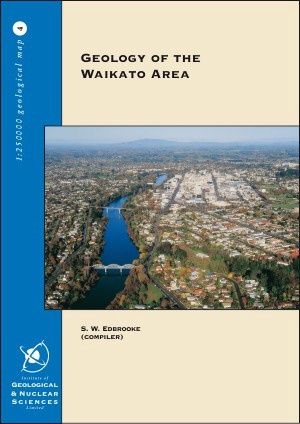
Geology Of The Waikato Area
$35
Price incl. GST (15%) $4.57
In stock: 1 available
Product details
Edbrooke, S.W. 2005
Geology of the Waikato area. Lower Hutt: Institute of Geological & Nuclear Sciences. Institute of Geological & Nuclear Sciences 1:250,000 geological map 4. 68 p. + 1 folded map
Abstract
The Waikato 1:250,000 geological map covers approximately 11,000 km² of the Waikato, King Country, and north Taranaki regions in the west of the North Island, New Zealand.
Key Geological Features
- Hamilton Lowland Area:
- Extensive plains bordered by dissected hills and ranges.
- Formed mainly on Mesozoic basement rocks with a thin cover of Tertiary sedimentary rocks.
- Includes limestone areas near Waitomo, forming karst landscapes.
- Volcanic Features:
- Cones of Karioi, Pirongia, and Kakepuku volcanoes rise above surrounding hills and plains in the north.
- Quaternary ignimbrites cap or bury hills southeast of the lowlands, shaping the main landscape.
- Hill Country:
- Dissected hills formed on Miocene sedimentary rocks dominate the southern and southwestern areas.
- Coastal Dunes:
- Extensive dunes north of Marokopa, especially near the entrances to Kawhia, Aotea, and Raglan harbours.
Offshore Features
- The seafloor slopes gently westward for 50 km in the north and over 150 km in the south, reaching the shelf edge at about 150 m depth.
- Beyond the shelf edge, the seafloor deepens rapidly to over 1000 m.
- Gannet Island, 20 km west of Aotea Harbour, is the only offshore island.
Geological Composition
-
Basement Rocks:
- Late Paleozoic to Mesozoic rocks form parts of three tectonostratigraphic terranes:
- Murihiku Terrane: Late Triassic to Late Jurassic rocks folded into the Kawhia Regional Syncline.
- Dun Mountain-Maitai Terrane: Represented by a serpentinite body at Wairere, faulted against the Murihiku terrane by the Waipa Fault.
- Waipapa (Composite) Terrane: Mainly volcaniclastic sandstones east of the Waipa Fault.
- Offshore basement rocks west of the Taranaki Fault are likely part of the Brook Street Terrane, with those further west being part of the Median Batholith.
- Late Paleozoic to Mesozoic rocks form parts of three tectonostratigraphic terranes:
-
Cover Rocks:
- Eocene to Late Miocene sedimentary rocks (Te Kuiti, Waitemata, Mahoenui, Mokau, Wai-iti, and Whangamomona groups).
- Pliocene and Quaternary sediments include:
- Coastal sands: Awhitu and Karioitahi groups.
- Terrestrial alluvium: Tauranga Group.
- Volcanism:
- Early Miocene: Carbonate-dominated sediments transitioned to terrigenous sediments in subsiding basins.
- Pliocene and Early Quaternary: Back-arc volcanism created the Orangiwhao Intrusive Group and basalts of the Alexandra and Kerikeri volcanic groups.
- Quaternary: Caldera-forming eruptions in the Taupo Volcanic Zone deposited ignimbrites and tephra (Pakaumanu, Whakamaru, Taupo, and Oruanui formations).
-
Offshore Sediments:
- West of the Taranaki Fault lies an almost continuous Cretaceous-Cenozoic sequence up to 8000 m thick.
Geological Resources
The Waikato map area contains a variety of geological resources:
- Ironsand deposits along the coast.
- Sub-bituminous coals in the Waikato and Taranaki coalfields.
- Large reserves of aggregate, limestone, and sand.
- Locally extensive groundwater aquifers.
- Hot water springs and warm groundwater (though no high-temperature geothermal fields).
- Offshore oil and gas potential, with further discoveries expected.
Geological Hazards
The Waikato area faces several geological hazards:
- Volcanic Hazards:
- Significant threat from future volcanic activity in the Taupo Volcanic Zone (TVZ).
- Lesser threat from eruptions of Mayor Island and Taranaki Volcano.
- Volcanic ash deposits could significantly impact the environment and human activity.
- Pyroclastic flows from violent TVZ eruptions would be extremely destructive.
- Seismic Activity:
- Low to moderate seismicity compared to other areas of New Zealand.
- Turi Fault (offshore) is the only known active fault in the area.
- Local damage has occurred from infrequent moderate magnitude, shallow earthquakes within or near the area, and larger magnitude earthquakes further away.
- Other Hazards:
- Landslides on weak rocks.
- Coastal damage from tsunamis.
- Flooding of low-lying areas after prolonged, high-intensity rainfall.
This comprehensive geological map and accompanying report provide essential insights into the geology, resources, and hazards of the Waikato area, making it an invaluable resource for researchers, planners, and geologists.
Geology Of The Waikato Area
Display prices in:NZD