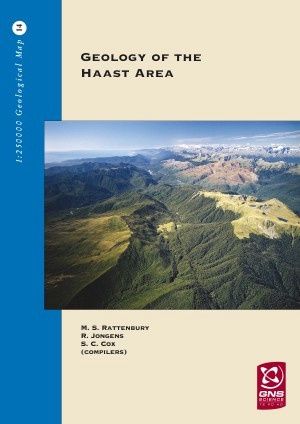
Geology Of The Haast Area
$35
Sold out
Price incl. GST (15%) $4.57
Sold out
Product details
Authors and Publication Information
Rattenbury, M.S.; Jongens, R.; Cox, S.C. (comps) 2010
Geology of the Haast area. Lower Hutt: GNS Science.
Institute of Geological & Nuclear Sciences 1:250,000 geological map 14
58 p. + 1 folded map
Abstract
The Haast 1:250,000 geological map provides detailed coverage of 6348 km² of onshore South Westland and northwest Otago in the South Island of New Zealand. This area straddles the Pacific and Australian tectonic plates, featuring notable fault lines such as the Alpine and Livingstone faults, which juxtapose diverse Paleozoic to Mesozoic rocks across six tectonostratigraphic terranes.
Key Geological Features
-
Northwest of the Alpine Fault
- Early Paleozoic metasedimentary and plutonic basement rocks, remnants of the Gondwana supercontinent.
- Includes:
- Buller Terrane (Western Province) represented by the metasedimentary Greenland Group.
- Mid-Paleozoic granitic rocks of the Karamea and Paringa suites.
-
Southeast of the Alpine Fault
- Mesozoic rocks (Eastern Province) accreted to the Gondwana margin.
- Includes:
- Deformed and attenuated Permian-Jurassic terranes: Brook Street, Murihiku, Dun Mountain-Maitai, Rakaia, and Caples.
- Metamorphosed Rakaia and Caples terranes collectively termed the Haast Schist.
Geological Evolution Timeline
-
Late Early Cretaceous:
- Uplift of Eastern and Western provinces, forming a stable basement for younger Cretaceous and Cenozoic sedimentation.
- Start of Gondwana's break-up, leading to the opening of the Tasman Sea.
-
Late Early to Late Cretaceous & Late Cenozoic:
- Localised fault activity and clastic sedimentary basin development.
- Intervening deposition of widespread limestone and mudstone during Paleocene, Eocene, and Oligocene.
-
Paleocene to Oligocene:
- Passive margin environments with sedimentation punctuated by intraplate basaltic volcanism.
-
Early Miocene:
- Development of the modern Australian-Pacific plate boundary as a major structural entity.
-
Late Cenozoic:
- Clastic sedimentation influx due to oblique-compressional plate boundary development.
- Uplift of the Southern Alps and other ranges.
-
Quaternary Period:
- Glacial-interglacial climatic fluctuations:
- Deposition of unconsolidated Quaternary tills and glacial outwash gravels.
- High sea levels during interglacial periods, forming marine terraces and isolated beach deposits, later uplifted.
- Ongoing mountain growth through folding and faulting.
- Glacial-interglacial climatic fluctuations:
Natural Hazards
-
Earthquakes:
- High potential for Alpine Fault earthquake shaking, causing landslides, liquefaction, and ground rupture.
- Three magnitude 6+ earthquakes have occurred in the last 70 years.
-
Slope Instability:
- Includes landslides, rock avalanches, rockfalls, and debris flows in hill and mountain terrain.
-
Erosion, Flooding, and Sedimentation:
- Hazards near watercourses.
-
Tsunami Risk:
- Low-lying coastal and lakeside areas are vulnerable.
Mineral Resources
-
Mined Resources:
- Alluvial gold and rock aggregate.
-
Non-Metallic Minerals:
- Pounamu (nephrite/greenstone) and kyanite, valued locally.
-
Other Recorded Minerals:
- Chromium, copper, nickel, ilmenite, and scheelite.
-
Hydrocarbons:
- No recorded oil or gas seeps, no commercial hydrocarbon extraction, and no petroleum exploration wells.
- Potential Paleogene source and reservoir sedimentary rocks may exist offshore, 3-5 km below sea level.
Geology Of The Haast Area
Display prices in:NZD