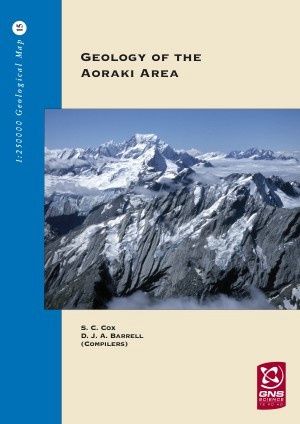
Geology Of The Aoraki Area
$35
Sold out
Price incl. GST (15%) $4.57
Sold out
Product details
Cox, S.C.; Barrell, D.J.A. (comps) 2007
Geology of the Aoraki area. Lower Hutt: GNS Science.
Institute of Geological & Nuclear Sciences 1:250,000 geological map 15
71 p. + 1 folded map
Abstract
The Aoraki 1:250 000 geological map covers 24 000 km² of South Westland and central parts of the Canterbury region in the South Island of New Zealand. It encompasses the highest part of the Southern Alps, including 3754-m high Aoraki/Mt Cook.
The map area is crossed by the Alpine Fault – a major strike-slip fault that marks the boundary between the Australian and Pacific tectonic plates. Neogene movement along the plate boundary has brought together two different pre-Cretaceous geological provinces:
-
Northwest of the Alpine Fault:
Paleozoic metasedimentary and plutonic basement rocks are fragments of the Gondwanaland supercontinent. -
Southeast of the Alpine Fault:
The Torlesse composite terrane is a thick, deformed package of Carboniferous-Jurassic sedimentary and metasedimentary basement rocks that were accreted to the Gondwanaland margin.
Geological History
-
Early Cretaceous:
The break-up of Gondwanaland began, accompanied by igneous activity, extension, and subsidence. -
Late Cretaceous and Paleogene:
Progressive regional submergence in the eastern part of the map area led to deposition of a terrestrial to marine transgressive sequence of conglomerates, sandstones, and mudstones. -
Middle Oligocene:
Land extent reached a minimum, with widespread deposition of calcareous sediments in surrounding seas. -
Early Miocene:
Development of the Australian-Pacific plate boundary began, causing:- West of the Alpine Fault: Subsidence and deposition of marine sediments.
- East of the Alpine Fault: Progressive emergence of land, formation of ranges and basins, erosion, and deposition.
-
Present Day:
Uplift by folding and faulting continues throughout much of the central map area, while subsidence occurs beneath parts of the Canterbury Plains and offshore.
Quaternary and Mineral Resources
-
Late Neogene climatic fluctuations:
Glacial-interglacial periods resulted in widespread deposition of unconsolidated Quaternary sediments. -
Metallic mineral occurrences:
- Mostly restricted to South Westland.
- Includes hard-rock and alluvial gold deposits and mineral-rich beach sands.
- Pounamu/greenstone is a locally important non-metallic mineral.
-
Canterbury resources:
- Coal, clay, and sand extracted from the Cretaceous-Cenozoic sedimentary sequence.
- Potential for hydrocarbons beneath the Canterbury Plains or offshore.
- Vast resources of limestone and aggregate.
-
Groundwater resources:
- Substantial shallow groundwater resources widely utilised in low-rainfall areas east of the Southern Alps.
- Deeper groundwater resources are less known but may be needed for future development.
Geological Hazards
The Aoraki map area is vulnerable to significant geological hazards:
-
Earthquakes:
Associated with the Alpine Fault and other active faults, with potential for strong ground shaking, landsliding, liquefaction, and ground rupture. -
Slope instability:
Includes rock avalanches, rockfalls, and debris flows in hill and mountain terrain. -
Watercourse hazards:
Erosion, flooding, and sedimentation near rivers and streams. -
Coastal and lake hazards:
Low-lying areas are potentially at risk from tsunamis.
Geology Of The Aoraki Area
Display prices in:NZD