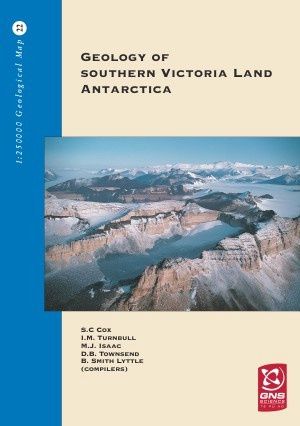
Geology Of Southern Victoria Land Antarctica
$35
Price incl. GST (15%) $4.57
In stock: 1 available
Product details
Cox, S.C.; Turnbull, I.M.; Isaac, M.J.; Townsend, D.B.; Smith Lyttle, B. (comps) 2012
Geology of southern Victoria Land Antarctica. Lower Hutt: GNS Science. Institute of Geological & Nuclear Sciences 1:250,000 geological map 22 135 p. + 1 folded map
Abstract
The “Geology of southern Victoria Land” is a 1:250 000 map and monograph that describes the geology of the largest ice-free area in Antarctica. It covers the region between the Fry Glacier in the north and the Skelton Glacier in the south (~76°30’S–78°45’S), and from the Polar Plateau to Ross Island (158°E–170°E). This map replaces a 1:250 000 map published in 1962.
Key features include:
- Geological information obtained from published and unpublished mapping by researchers from GNS Science, New Zealand universities, and the United States Antarctic Program.
- An illustrated text summarising the geology and landforms of the area, as well as previous geological exploration.
- An appendix with a lexicon of adopted stratigraphic names, unit codes, and descriptions.
- All geological data stored in a Geographic Information System, available in digital format.
Geological Highlights
The region is crossed by a major rift basin, with its uplifted shoulder forming the Transantarctic Mountains escarpment. Key geological features include:
- Large stratovolcanoes on Ross Island and the nearby mainland.
- Neoproterozoic and Paleozoic granitoids, and their host rocks, overlain by a thick sequence of Devonian-Triassic sedimentary rocks.
- Jurassic dolerite sills, Eocene to Holocene deposits in the Dry Valleys, and beneath the Ross Sea.
- A record of ice sheet and glacier fluctuations preserved in Miocene and later volcanic products.
Detailed Mapping
The map differentiates:
- Neoproterozoic Skelton Group: Metasedimentary rocks of greenschist to amphibolite facies.
- Granite Harbour Intrusive Complex: Late Proterozoic to early Paleozoic granitic plutons classified into four petrogenetic suites.
- Beacon Supergroup: Sedimentary rocks including the Devonian Taylor Group and the Permian to Triassic Victoria Group, further divided into 12 formations.
- Jurassic Ferrar Group: Dolerite sills and dikes intruding both basement and Beacon Supergroup rocks, along with the extrusive Mawson Formation and Kirkpatrick Basalt.
- Cenozoic volcanic rocks: McMurdo Volcanic Group of Mt Erebus/Ross Island and the southern Ross Sea region.
Additional Features
- Structural features of the Victoria Land Basin depicted on the cross-section.
- Miocene-Holocene glacial deposits (tills and drift), lacustrine, coastal, and slope deposits differentiated based on lithology, weathering, geomorphology, and limited dating.
(auth)
Geology Of Southern Victoria Land Antarctica
Display prices in:NZD